









Позитивные изменения. Том 4, №1 (2024). Positive changes. Volume 4, Issue 1 (2024) - Редакция журнала «Позитивные изменения»
Книгу Позитивные изменения. Том 4, №1 (2024). Positive changes. Volume 4, Issue 1 (2024) - Редакция журнала «Позитивные изменения» читаем онлайн бесплатно полную версию! Чтобы начать читать не надо регистрации. Напомним, что читать онлайн вы можете не только на компьютере, но и на андроид (Android), iPhone и iPad. Приятного чтения!
206 0 09:04, 02-06-2024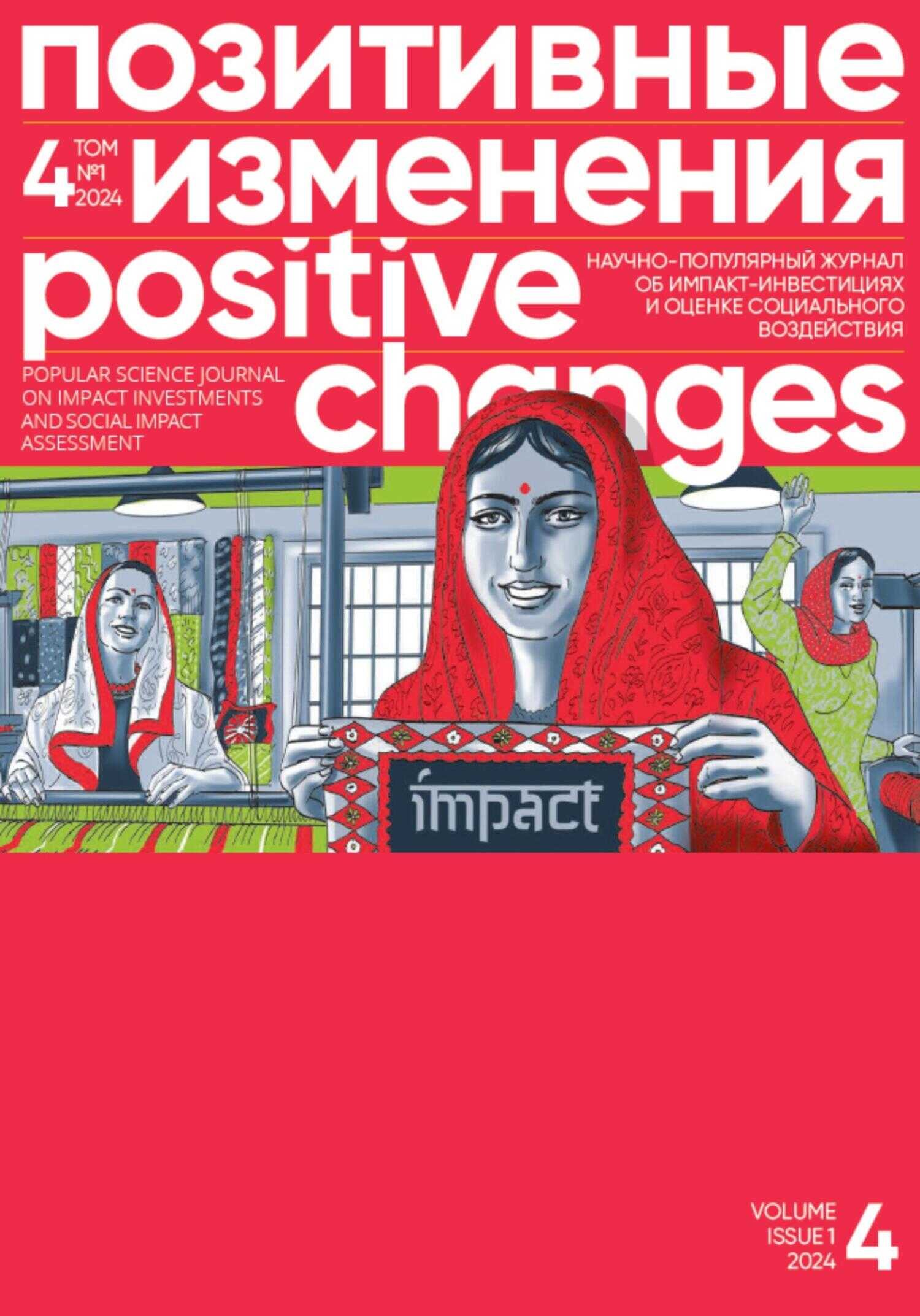
Книга Позитивные изменения. Том 4, №1 (2024). Positive changes. Volume 4, Issue 1 (2024) - Редакция журнала «Позитивные изменения» читать онлайн бесплатно без регистрации
Весенний выпуск журнала «Позитивные изменения» посвящен анализу сложного, многогранного и интересного опыта в реализации и оценке программ развития территорий. В этом выпуске мы также обсудим очередной актуальный вопрос повестки — разрабатываемый в России стандарт отчетности об устойчивом развитии компаний, рассмотрим, что в нем учтено, а что требует доработки. Мы также поговорим о том, как может выглядеть добрый город, как считается индекс коммуникационной состоятельности городов, каковы факторы корпоративного благополучия в НКО, а также в чем суть концепции позитивного развития молодежи. Гостем выпуска стала уникальный предприниматель из Индии Сумита Гхош, которая является создателем модели развития территорий через обеспечение рабочими местами более 3 тысяч человек. И все это традиционно для того, чтобы еще больше добрых «зерен» прорастало в пространстве вдохновения, знаний и веры в позитивные изменения.
10. Arnett, J. (2015). Does Emerging Adulthood Theory Apply Across Social Classes?
National Data on a Persistent Question. Emerging Adulthood, 4(4), 227–235. https://doi.org/10.1177/2167696815613000
11. Arnett, J. J. (2015). Identity development from adolescence to emerging adulthood: what we know and (especially) don’t know. In the Oxford handbook of identity development, pp. 53–64. https://doi.org/10.1093/oxfordhb/9780199936564.013.009
12. Bowers, E., Li, Y., Kiely, M., Brittian, A., Lerner, J. & Lerner, R. (2010). The Five Cs Model of Positive Youth Development: A Longitudinal Analysis of Confirmatory Factor Structure and Measurement Invariance. Journal of Youth and Adolescence, 39, 720–735. https://doi.org/10.1007/s10964-010-9530-9
13. Bronfenbrenner, U. & Morris, P. A. (2007). The Bioecological Model of Human Development. Handbook of Child Psychology. https://doi. org/10.1002/9780470147658.CHPSY0114
14. Catalano, R. F., Skinner, M. L., Alvarado, G., Kapungu, C. & Petroni, S. (2019). Positive Youth Development Programs in Low- and Middle-Income Countries: A Conceptual Framework and Systematic Review of Efficacy. The Journal of Adolescent Health: Official Publication of the Society for Adolescent Medicine, 65(1), 15–31. https://doi.org/10.1016/j.jadohealth.2019.01.024
15. Ciocanel, O., Power, K., Eriksen, A. & Gillings, K. (2017). Effectiveness of Positive Youth Development Interventions: A Meta-Analysis of Randomized Controlled Trials. Journal of Youth and Adolescence, 46(3), 483–504. https://doi.org/10.1007/s10964-016-0555-6
16. Edin, K. & Kefalas, M. (2005). Unmarried with Children. Contexts, 4(2), 16–22. https://doi.org/10.1525/ctx.2005.4.2.16
17. Furstenberg, F. F. (2010). On a New Schedule: Transitions to Adulthood and Family Change. The Future of Children, 20(1), 67–87. https://doi.org/10.1353/foc.0.0038
18. Hendry, L. B. & Kloep, M. (2010). How universal is emerging adulthood? An empirical example. Journal of Youth Studies, 13(2), 169–179. https://doi.org/10.1080/13676260903295067
19. Karakulak, A., & Cüre-Acer, S. (2021). Book Review: Handbook of Positive Youth Development: Advancing the Next Generation of Research, Policy, and Practice in Global Contexts. Frontiers in Psychology, 12. https://doi.org/10.3389/ fpsyg.2021.716388
20. Lerner, R., Almerigi, J. B., Theokas, C., & Lerner, J. (2005). Positive Youth Development a View of the Issues. The Journal of Early Adolescence, 25(1), 10–16. https://doi.org/10.1177/0272431604273211
21. Silva, J. M. (2016). High Hopes and Hidden Inequalities: How Social Class Shapes Pathways to Adulthood. Emerging Adulthood, 4(4), 239–241. https://doi.org/10.1177/2167696815620965
22. Taylor, R. D., Oberle, E., Durlak, J. A. & Weissberg, R. P. (2017). Promoting Positive Youth Development Through School-Based Social and Emotional Learning Interventions: A Meta-Analysis of Follow-Up Effects. Child Development, 88(4), 1156–1171. https://doi.org/10.1111/cdev.12864
23. Waid, J. & Uhrich, M. (2020). Scoping Review of the Theory and Practice of Positive Youth Development. The British Journal of Social Work, 50(1), 5-24. https://doi.org/10.1093/bjsw/bcy130
24. Youngblade, L., Theokas, C. & Schulenberg, J. (2007). Risk and Promotive Factors in Families, Schools, and Communities: A Contextual Model of Positive Youth Development in Adolescence. Pediatrics. https://doi.org/10.1542/peds.2006-2089H
Develop Positively. Introducing a New Concept for the Prevention of Childhood and Adolescent Adversity
Anna Khegay
DOI 10.55140/2782-5817-2024-4-1-74-85
Focusing on the strengths, potential, and capabilities of adolescents and youth, rather than on mitigating the consequences of challenging behavior, encapsulates the principal notion of positive youth development. The concept began to gain momentum in the world in the 1990s.
In Russia as well, there are examples of non-governmental organizations that embrace and implement the principles of this approach in practice. The specifics of this concept, and how its application aids in the prevention of child and adolescent adversity, are explained by the expert from the Victoria Charitable Children’s Fund.[87]
Anna Khegay
Employee, Department of Psychology, instructor, postgraduate student, National Research University — Higher School of Economics, chief psychologist, and methodologist, Victoria Charitable Children’s Fund
RELEVANCESince the 2010s, more attention has been given in the Russian Federation to the importance of nurturing the potential of adolescents and young adults. The Youth Development Strategy until 2030 encompasses all Russian citizens aged 14 to 35 inclusive. One aim of the strategy is to assist young individuals in their quest for self-improvement, the betterment of the country, and the shaping of the future.
Around the globe, policy designers face the objective of actively engaging youth in civic existence, professional growth, and self-evolution. For instance, the European Youth Policy until 2027 includes ambitions such as equality for all young persons, inclusivity, constructive discourse, mental well-being, expansion of prospects for youth in rural zones and smaller cities, high-grade employment and learning opportunities for all youths, youth involvement in civil and political spheres, and the advancement of voluntary and youth groups. In this context, a particular challenge is engaging young people in active life, who are growing up in difficult life situations.
It is well-acknowledged that young adults enduring tough life conditions often navigate their adolescence and early adulthood as periods fraught with various challenges (Arnett, 2015), including entering a labor market that can be hostile towards youth (Edin & Kefalas, 2005; Furstenberg, 2010). A suite of qualitative inquiries (Hendry & Kloep, 2010; Silva, 2016; Arnett, 2015) indicates that adolescents with strenuous childhoods frequently perceive themselves as more mature earlier than their counterparts, due to the necessity of assuming substantial responsibilities prematurely.
As per Rosstat’s 2023 data, in the Russian Federation, approximately 25 % of all children and adolescents subsist below the poverty threshold, around 2 % have orphanhood experience, and nearly 7.5 % of children have restricted health abilities. Around 3.5 % of all children and adolescents have been directly impacted by military actions since 2022.[88] Consequently, a considerable portion of the Russian youth are presented with comparatively diminished initial opportunities to fulfill their potential.
In Russia, modern social work is regarded as a means for advancing




Прочитали книгу? Предлагаем вам поделится своим отзывом от прочитанного(прослушанного)! Ваш отзыв будет полезен читателям, которые еще только собираются познакомиться с произведением.
Уважаемые читатели, слушатели и просто посетители нашей библиотеки! Просим Вас придерживаться определенных правил при комментировании литературных произведений.
- 1. Просьба отказаться от дискриминационных высказываний. Мы защищаем право наших читателей свободно выражать свою точку зрения. Вместе с тем мы не терпим агрессии. На сайте запрещено оставлять комментарий, который содержит унизительные высказывания или призывы к насилию по отношению к отдельным лицам или группам людей на основании их расы, этнического происхождения, вероисповедания, недееспособности, пола, возраста, статуса ветерана, касты или сексуальной ориентации.
- 2. Просьба отказаться от оскорблений, угроз и запугиваний.
- 3. Просьба отказаться от нецензурной лексики.
- 4. Просьба вести себя максимально корректно как по отношению к авторам, так и по отношению к другим читателям и их комментариям.
Надеемся на Ваше понимание и благоразумие. С уважением, администратор LoveRead.info.
Оставить комментарий

-
 Ксения24 июнь 18:50
Очень понравился цикл книг "В самом сердце стужи". Интересная история, написанная с огромным вниманием к деталям. Не избитый...
В самом Сердце Стужи. Том VII - Александр Якубович
Ксения24 июнь 18:50
Очень понравился цикл книг "В самом сердце стужи". Интересная история, написанная с огромным вниманием к деталям. Не избитый...
В самом Сердце Стужи. Том VII - Александр Якубович
-
Riya23 июнь 00:13
Остані 20 сторінок ледве дочитала, сам роман тримав в напрузі, але воно того було варте хотілося щоб про Лоренса більше було і...
По праву вражды и истинности - Виктория Вашингтон
-
awaynice21 июнь 16:59
Книга в которой начинаешь сходить с ума вместе с героем: было или не было? Ксчастб, она короткая....
Эхо забвения - Хелен Гард