





Когда деньги говорят. История монет и нумизматики от древности до поп-культуры - Фрэнк Хольт
Книгу Когда деньги говорят. История монет и нумизматики от древности до поп-культуры - Фрэнк Хольт читаем онлайн бесплатно полную версию! Чтобы начать читать не надо регистрации. Напомним, что читать онлайн вы можете не только на компьютере, но и на андроид (Android), iPhone и iPad. Приятного чтения!
111 0 09:01, 02-10-2023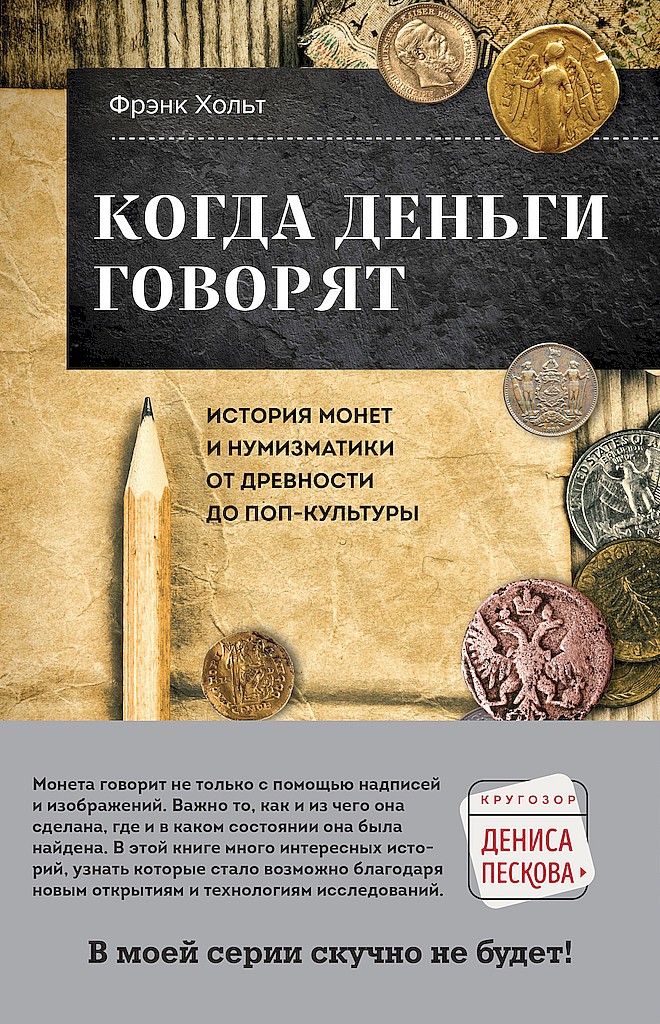
Книга Когда деньги говорят. История монет и нумизматики от древности до поп-культуры - Фрэнк Хольт читать онлайн бесплатно без регистрации
Историк Фрэнк Хольт приглашает нас в увлекательное путешествие по истории нумизматики, изучения монет — одного из старейших и важнейших вкладов в искусство и гуманитарные науки. Кто изобрел монеты и зачем? Функционирует ли чеканка вне нашего контроля, как если бы у нее был собственный разум? Как это изменило мировую историю и культуру? Что нумизматика может рассказать о нашем прошлом, чего нельзя было бы узнать из какого-либо другого источника? Как нумизматика продвинулась вперед с использованием современной науки?
Cotte J. «Du trе́sor au mе́daillier: le marchе́ des monnaies antiques dans la France du dе́but du XVIIe siècle». Bibliothèque de l’е́cole des chartes 154 (1996): 533–564.
Crawford M. Roman Republican Coinage. 2 vols. London: Cambridge University Press, 1974.
Crawford M. Coinage and Money under the Roman Republic. Berkeley: University of California Press, 1985.
Crawford M., et al., eds. Medals and Coins from Budе́ to Mommsen. London: Warburg Institute, 1990.
Cribb J., ed. Money: From Cowrie Shells to Credit Cards. London: British Museum, 1986.
Cribb J. «The Origins of Money, Evidence from the Ancient Near East and Egypt». In La Banca Premonetale. Ed. by G. Crapanzano. Pp. 35–78. Milan: Art Valley Association, 2004.
Crosby S. S. «The United States Cents of 1793». American Journal of Numismatics 3 (1869): 93–97.
Cuhaj G., ed. Standard Catalog of United States Paper Money. 32nd ed. Iola, KS: Krause Publications, 2013,
Cunnally J. «Ancient Coins as Gifts and Tokens of Friendship during the Renaissance». Journal of the History of Collections 6 (1994): 129–143.
Cunnally J. Images of the Illustrious: The Numismatic Presence in the Renaissance. Princeton, NJ: Princeton University Press, 1999.
Cunnally J. «The Portable Pantheon: Ancient Coins as Sources of Mythological Imagery in the Renaissance». In Wege zum Mythos. Ed. by L. Freedman, G. Huber-Rebenich. Pp. 123–140. Berlin: Mann, 2001.
Cunnally J. Irritamenta: Numismatic Treasures of a Renaissance Collector. 2 vols. New York: American Numismatic Society, 2016.
Curiel R., Fussman G. Le Trе́sor monе́taire de Qunduz. Paris: Klincksieck, 1965.
Dale A. «WALWET and KUKALIM». Kadmos 54 (2015): 151–166.
Davies G. A History of Money. 3rd ed. Cardiff: University of Wales Press, 2002.
Davis G. «Mining Money in Late Archaic Athens». Historia 63 (2014): 257–277.
Davis N., Kraay C. The Hellenistic Kingdoms: Portrait Coins and History. London: Thames and Hudson, 1973.
della Porta G. De Humana Physiognomonia. Vico Equense: Iosephus Cacchius, 1586.
Denisova A. Internet Memes and Society: Social, Cultural, and Political Contexts. New York: Routledge, 2019.
Deyell J. «Greek Minting in Bactria: Engravers, Dies and Coin Production». In From Local to Global: Papers in Asian History and Culture. Ed. by K. Sheel, C. Willemen, K. Zysk. Pp. 28–50. New Delhi: Buddhist World Press, 2017.
Dolley R. «A Further Note on the Harkirke Find». Numismatic Chronicle 15 (1955): 189–193.
Domergue C. Les mines antiques. La production des mе́taux aux е́poques grecque et romaine. Paris: Picard, 2008.
Doty R. The Macmillan Encyclopedic Dictionary of Numismatics. New York: Macmillan, 1982.
Doyen J.-M. «Archaeology and Numismatics: Can We Reconcile the ‘Fraternal Enemies’?» Journal of Archaeological Numismatics 1 (2011): i — viii.
Doyen J.-M. «The ‘Charon’s Obol’: Some Methodological Reflexions». Journal of Archaeological Numismatics 2 (2012): i — xviii.
Drower M. Flinders Petrie: A Life in Archaeology. Madison: University of Wisconsin Press, 1995.
Duffy E. The Stripping of the Altars: Traditional Religion in England, 1400–1580. 2nd ed. New Haven, CT: Yale University Press, 2005.
Duncan-Jones R. Money and Government in the Roman Empire. Cambridge: Cambridge University Press, 1994.
Duyrat F. «L’avenir des е́tudes numismatiques, entre numе́risation et corpus en ligne». Comptes rendus de l’Acadе́mie des Inscriptions et Belles-Lettres (April-June 2015): 867–882.
Duyrat F. Wealth and Warfare: The Archaeology of Money in Ancient Syria. New York: American Numismatic Society 2016.
Eckhel J. Doctrina numorum veterum. 8 vols. Vienna: J. Camesina, 1792–1798.
Ekman M. «The Birth of the Museum in the Nordic Countries». Nordic Museology 1 (2018): 5–26.
Elkins N. «Ancient Coins, Find Spots, and Import Restrictions: A Critique of Arguments Made in the Ancient Coin Collectors Guild’s ‘Test Case’». Journal of Field Archaeology 40 (2015): 236–243.
Elkins N. «Publicizing Victory: The Frequency and Audience of Flavian ‘Judaea Capta’ Coins from the Imperial Mints». Israel Numismatic Research 14 (2019): 117–130.
Ellis S. «Re-evaluating Pompeii’s Coin Finds». In The Economy of Pompeii. Ed. by M. Flohr, A. Wilson. Pp. 293–337. Oxford: Oxford University Press, 2017.
Evans J. «The Coinage of the Ancient Britons, and Natural Selection». Notices of the Proceedings at the Meetings of the Members of the Royal Institution of Great Britain 7 (1875): 476–487.
Evans J. The Coins of the Ancient Britons: Supplement. London: B. Quaritch, 1890.
Evelyn J. Numismata: A Discourse of Medals, Antient and Modern. London: Benjamin Tooke, 1697.
Faucher T. Frapper monnaie: La fabrication des monnaies de bronze à Alexandrie sous les Ptolе́mе́es. Alexandria: Centre d’Études Alexandrines, 2013.
Faucher T. «Coin Minting Techniques in Ptolemaic Egypt: Observe, Analyze, Recreate». Notae Numismaticae 12 (2017): 71–87.
Faucher T. «Ptolemaic Gold: The Exploitation of Gold in the Eastern Desert». In The Eastern Desert of Egypt during the Greco-Roman Period: Archaeological Reports. Ed. by J.-P. Brun et al. Pp. 1–16. Paris: Collège de France, 2018.
Ferguson N. The Ascent of Money. New York: Penguin, 2008.
Fiffer S. Tyrannosaurus Sue. New York: W. H. Freeman, 2000.
Fischer S., Lind L. «The Coins in the Grave of King Childeric». Journal of Archaeology and Ancient History 14 (2015): 3–36.
Fischer-Bossert W. Chronologie der Didrachmenprägung von Tarent, 510–280 v. Chr. Berlin: Walter De Gruyter, 1999.
Fitzpatrick S. «The Famous Stone Money of Yap». In The Archaeology of Money. Ed. by C. Haselgrove, S. Krmnicek. Pp. 43–66. Leicester: School of Archaeology and Ancient History, 2016.
Focardi S. Money. New York: Routledge, 2018.
da Fonseca T. A. P., Pessôa R., Sanabani S. S. «Molecular Analysis of Bacterial Microbiota on Brazilian Currency Note Surfaces». International Journal of Environmental Research and Public Health 12 (2015): 13276–13288.
Fontana F. M. Testimoni parlanti: Le monete antiche a Roma tra Cinquecento e Seicento. Rome: Edizioni Quasar, 2009.
Franco P. Understanding Bitcoin: Cryptography, Engineering, and Economics. Chichester: Wiley, 2015.
Franzoni C. «Amphinomos e Anapias a Catania: Per la storia di due statue ellenistiche perdute». Kokalos 41 (1995): 209–227.
Freedman L. «Titian’s Jacopo da Strada: A Portrait of an ‘Antiquario.’» Renaissance Studies 13 (1999): 15–39.
Freeland C. Portraits and Persons: A Philosophical Inquiry. Oxford: Oxford University Press, 2010.
Friedberg A. Coins of the Bible. Atlanta, GA: Whitman, 2004.
Friedlaender J. «Überprägte antike Münzen». Zeitschrift für Numismatik 4 (1877): 328–349.
Friedman M. Money Mischief: Episodes in Monetary History. New York: Harcourt Brace, 1994.
Fulvio A. Illustrium Imagines. Rome: Jacob Mazochius, 1517.
Galton F. «Generic Images». Proceedings of the Royal Institution 9 (1879): 161–170.
Galton F. Hereditary Genius: An Inquiry into its Laws and Consequences. London: Macmillan, 1869.
Gardner P. Autobiographica. Oxford: Basil Blackwell, 1933.
Gе́nе́brier C. Histoire de Carausius, Empereur de la Grande Bretagne. Paris: Jacques Guerin, 1740.
Gе́rin-Ricard H. de, l’abbе́ d’Agnel A. «Dе́couverte d’un trе́sor à Tourves en 1366». Revue numismatique 7 (1903): 164–168.
Gerloff W. Die Entstehung des
Прочитали книгу? Предлагаем вам поделится своим отзывом от прочитанного(прослушанного)! Ваш отзыв будет полезен читателям, которые еще только собираются познакомиться с произведением.
Уважаемые читатели, слушатели и просто посетители нашей библиотеки! Просим Вас придерживаться определенных правил при комментировании литературных произведений.
- 1. Просьба отказаться от дискриминационных высказываний. Мы защищаем право наших читателей свободно выражать свою точку зрения. Вместе с тем мы не терпим агрессии. На сайте запрещено оставлять комментарий, который содержит унизительные высказывания или призывы к насилию по отношению к отдельным лицам или группам людей на основании их расы, этнического происхождения, вероисповедания, недееспособности, пола, возраста, статуса ветерана, касты или сексуальной ориентации.
- 2. Просьба отказаться от оскорблений, угроз и запугиваний.
- 3. Просьба отказаться от нецензурной лексики.
- 4. Просьба вести себя максимально корректно как по отношению к авторам, так и по отношению к другим читателям и их комментариям.
Надеемся на Ваше понимание и благоразумие. С уважением, администратор LoveRead.info.
Оставить комментарий

-
 Ольга20 июнь 23:30
Очень миленько. Но не характерно для автора. До последней строчки была в напряжении, кто погибне т....
Бывший. Добьюсь тебя снова - Марта Макова
Ольга20 июнь 23:30
Очень миленько. Но не характерно для автора. До последней строчки была в напряжении, кто погибне т....
Бывший. Добьюсь тебя снова - Марта Макова
-
Анна19 июнь 19:20
Спасибо за ещё одну новиночку,так приятно и волнительно читать,особенно когда переплетается с другими историями....
Даже не сомневайся - Юлия Резник
-
Анна15 июнь 07:43
[spoiler][книга интересная,но не полная и к концу главы повторяются....
Кириленко Ирина – Бирюк