







Тело помнит все - Бессел ван дер Колк
Книгу Тело помнит все - Бессел ван дер Колк читаем онлайн бесплатно полную версию! Чтобы начать читать не надо регистрации. Напомним, что читать онлайн вы можете не только на компьютере, но и на андроид (Android), iPhone и iPad. Приятного чтения!
1 614 0 10:00, 14-08-2020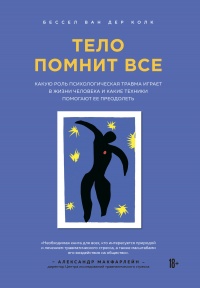
Книга Тело помнит все - Бессел ван дер Колк читать онлайн бесплатно без регистрации
http://www.nytimes.com/2010/09/02/business/02kids.html?pagewanted=all&_r=0
61. M. Olfson, et al., “National Trends in the Ofce-Based Treatment of Children, Adolescents, and Adults with Antipsychotics”, Archives of General Psychiatry 69, no. 12 (2012): 1247–56.
62. E. Harris, et al., “Perspectives on Systems of Care: Concurrent Mental Health Therapy Among Medicaid-Enrolled Youths Starting Antipsychotic Medications”, FOCUS 10, no. 3 (2012): 401–7.
63. B. A. van der Kolk, “The Body Keeps the Score: Memory and the Evolving Psychobiology of Posttraumatic Stress”, Harvard Review of Psychiatry 1, no. 5 (1994): 253–65.
64. B. Brewin, “Mental Illness Is the Leading Cause of Hospitalization for Active-Duty Troops”, Nextgov.com, May 17, 2012, http://www.nextgov.com/health/2012/05/mental-illness-leading-cause-hospitalization-active-duty-troops/55797/.
65. Mental health drug expenditures, Department of Veterans affairs.
http://www.veterans.senate.gov/imo/media/doc/For%20the%20Record%20-%20CCHR%204.30.14.pdf.
1. Dr. Spencer Eth to Bessel A. van der Kolk, March 2002.
2. J. Breuer and S. Freud, “The Physical Mechanisms of Hysterical Phenomena”, in The Standard Edition of the Complete Psychological Works of Sigmund Freud (London: Hogarth Press, 1893). J. Breuer and S. Freud, Studies on Hysteria (New York: Basic Books, 2009).
3. T. E. Lawrence, Seven Pillars of Wisdom (New York: Doubleday, 1935).
4. E. B. Foa, et al., “The Posttraumatic Cognitions Inventory (PTCI): Development and Validation”, Psychological Assessment 11, no. 3 (1999): 303–14.
5. K. Marlantes, What It Is Like to Go to War (New York: Grove Press, 2011).
6. Там же, стр. 114.
7. Там же, стр. 129.
8. H. Keller, The World I Live In (1908), ed. R. Shattuck (New York: NYRB Classics, 2004). См. также: R. Shattuck, “A World of Words”, New York Review of Books, February 26, 2004.
9. H. Keller, The Story of My Life, ed. R. Shattuck and D. Herrmann (New York: Norton, 2003).
10. W. M. Kelley, et al., “Finding the Self? An Event-Related fMRI Study”, Journal of Cognitive Neuroscience 14, no. 5 (2002): 785–94. См. также: N. A. Farb, et al., “Attending to the Present: Mindfulness Meditation Reveals Distinct Neural Modes of Self-Reference”, Social Cognitive and Affective Neuroscience 2, no. 4 (2007): 313–22. P. M. Niedenthal, “Embodying Emotion”, Science 316, no. 5827 (2007): 1002–5; and J. M. Allman, “The Anterior Cingulate Cortex”, Annals of the New York Academy of Sciences 935, no. 1 (2001): 107–17.
11. J. Kagan, dialogue with the Dalai Lama, Massachusetts Institute of Technology, 2006. http://www.mindandlife.org/about/history/.
12. A. Goldman and F. de Vignemont, “Is Social Cognition Embodied?” Trends in Cognitive Sciences 13, no. 4 (2009): 154–59. См. также: A. D. Craig, “How Do You Feel-Now? The Anterior Insula and Human Awareness”, Nature Reviews Neuroscience 10 (2009): 59–70; H. D. Critchley, “Neural Mechanisms of Autonomic, Affective, and Cognitive Integration”, Journal of Comparative Neurology 493, no. 1 (2005): 154–66; T. D. Wager, et al., “Prefrontal-Subcortical Pathways Mediating Successful Emotion Regulation”, Neuron 59, no. 6 (2008): 1037–50; K. N. Ochsner, et al., “Rethinking Feelings: An fMRI Study of the Cognitive Regulation of Emotion”, Journal of Cognitive Neuroscience 14, no. 8 (2002): 1215–29; A. D’Argembeau, et al., “Self-Reflection Across Time: Cortical Midline Structures Differentiate Between Present and Past Selves”, Social Cognitive and Affective Neuroscience 3, no. 3 (2008): 244–52; Y. Ma, et al., “Sociocultural Patterning of Neural Activity During Self-Reflection”, Social Cognitive and Affective Neuroscience 9, no. 1 (2014): 73–80; R. N. Spreng, R. A. Mar, and A. S. Kim, “The Common Neural Basis of Autobiographical Memory, Prospection, Navigation, Theory of Mind, and the Default Mode: A Quantitative Meta-Analysis”, Journal of Cognitive Neuroscience 21, no. 3 (2009): 489–510; H. D. Critchley, “The Human Cortex Responds to an Interoceptive Challenge”, Proceedings of the National Academy of Sciences of the United States of America 101, no. 17 (2004): 6333–34; and C. Lamm, C. D. Batson, and J. Decety, “The Neural Substrate of Human Empathy: Effects of Perspective-Taking and Cognitive Appraisal”, Journal of Cognitive Neuroscience 19, no. 1 (2007): 42–58.
13. J. W. Pennebaker, Opening Up: The Healing Power of Expressing Emotions (New York: Guilford Press, 2012), 12.
14. Там же, стр. 19.
15. Там же, стр. 35.
16. Там же, стр. 50.
17. J. W. Pennebaker, J. K. Kiecolt-Glaser, and R. Glaser, “Disclosure of Traumas and Immune Function: Health Implications for Psychotherapy”, Journal of Consulting and Clinical Psychology 56, no. 2 (1988): 239–45.
18. D. A. Harris, “Dance/ Movement Therapy Approaches to Fostering Resilience and Recovery Among African Adolescent Torture Survivors”, Torture 17, no. 2 (2007): 134–55; M. Bensimon, D. Amir, and Y. Wolf, “Drumming Trough Trauma: Music Therapy with Posttraumatic Soldiers”, Arts in Psychotherapy 35, no. 1 (2008): 34–48; M. Weltman, “Movement Therapy with Children Who Have Been Sexually Abused”, American Journal of Dance Therapy 9, no. 1 (1986): 47–66; H. Englund, “Death, Trauma and Ritual: Mozambican Refugees in Malawi”, Social Science & Medicine 46, no. 9 (1998): 1165–74; H. Teferi, Building on Traditional Strengths: The Unaccompanied Refugee Children from South Sudan (1996); D. Tolfree, Restoring Playfulness: Different Approaches to Assisting Children Who Are Psychologically Affected by War or Displacement (Stockholm: Rädda Barnen, 1996), 158–73; N. Boothby, “Mobilizing Communities to Meet the Psychosocial Needs of Children in War and Refugee Crises”, in Minefields in Their Hearts: The Mental Health of Children in War and Communal Violence, ed. R. Apfel and B. Simon (New Haven, CT: Yale University Press, 1996), 149–64; S. Sandel, S. Chaiklin, and A. Lohn, Foundations of Dance/ Movement Therapy: The Life and Work of Marian Chace (Columbia, MD: American Dance Therapy Association, 1993); K. Callaghan, “Movement Psychotherapy with Adult Survivors of Political Torture and Organized Violence”, Arts in Psychotherapy 20, no. 5 (1993): 411–21; A. E. L. Gray, “The Body Remembers: Dance Movement Therapy with an Adult Survivor of Torture”, American Journal of Dance Therapy 23, no. 1 (2001): 29-43.
19. A. M. Krantz, and J. W. Pennebaker, “Expressive Dance, Writing, Trauma, and Health: When Words Have a Body”, Whole Person Healthcare 3 (2007): 201–29.
20. P. Fussell, The Great War and Modern Memory (London: Oxford University Press, 1975).



Прочитали книгу? Предлагаем вам поделится своим отзывом от прочитанного(прослушанного)! Ваш отзыв будет полезен читателям, которые еще только собираются познакомиться с произведением.
Уважаемые читатели, слушатели и просто посетители нашей библиотеки! Просим Вас придерживаться определенных правил при комментировании литературных произведений.
- 1. Просьба отказаться от дискриминационных высказываний. Мы защищаем право наших читателей свободно выражать свою точку зрения. Вместе с тем мы не терпим агрессии. На сайте запрещено оставлять комментарий, который содержит унизительные высказывания или призывы к насилию по отношению к отдельным лицам или группам людей на основании их расы, этнического происхождения, вероисповедания, недееспособности, пола, возраста, статуса ветерана, касты или сексуальной ориентации.
- 2. Просьба отказаться от оскорблений, угроз и запугиваний.
- 3. Просьба отказаться от нецензурной лексики.
- 4. Просьба вести себя максимально корректно как по отношению к авторам, так и по отношению к другим читателям и их комментариям.
Надеемся на Ваше понимание и благоразумие. С уважением, администратор LoveRead.info.
Оставить комментарий

-
 Борис14 июнь 00:50
Колокола в России тем и отличались от западных что раскачиаали именно язык колокола,а не сам колокол! Авторы что-жертвы ЕГЭ? Не...
Соединенные Штаты России 3 - Полина Ром
Борис14 июнь 00:50
Колокола в России тем и отличались от западных что раскачиаали именно язык колокола,а не сам колокол! Авторы что-жертвы ЕГЭ? Не...
Соединенные Штаты России 3 - Полина Ром
-
Людмила Хофман10 июнь 22:13
У меня перевернулся мир после прочтения ваших книг! Так приятно и чисто на душе, ведь по сути неважно кто с кем , а только любовь...
Долгая игра - Рейчел Рид
-
Анна08 июнь 11:28
Спасибо за новую историю жизни и любви на сайте,прочитала с удовольствием ....
Давай поженимся - Юлия Резник